

September 20266 min read
Data Center Transformer Supply Chain Challenges
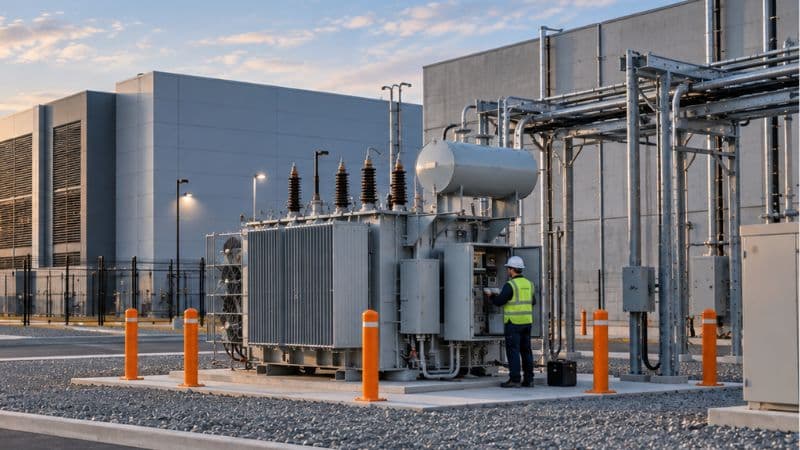
The data center transformer supply chain has become a major constraint on new capacity. As AI drives demand for more power-intensive facilities, operators, developers, utilities, and manufacturers are competing for the same transformers, components, and production capacity. At DSJ Global, we are seeing this translate into greater demand for supply chain professionals who can secure equipment earlier, strengthen supplier networks, and reduce project delays.
According to JLL's 2026 Global Data Center Outlook, average transformer lead times are around 100 weeks in EMEA, 43 weeks in the Americas, and 20 weeks in APAC. The wider impact on project delivery is already significant: 57% of data center projects experienced construction delays of three months or more in 2025, despite developers pre-ordering some critical materials as much as 24 months in advance. Transformer availability can therefore become a critical-path issue, delaying when completed facilities can be energised and brought online.
What is a transformer and why does it matter to a data center?
A transformer changes electrical power from one voltage level to another so it can be distributed safely through a data center. Utility power typically arrives at medium or high voltage, then transformers step it down to the levels required by the facility's electrical systems, including IT equipment, cooling, and other operational loads. Schneider Electric's guidance on data center electrical distribution explains how transformers fit into this power chain.
Without the right transformer infrastructure, a data center cannot distribute power as designed, even if construction and server installation are complete. As AI increases rack density and overall power demand, transformer availability is becoming closely tied to data center expansion.
Where is the transformer supply chain under the most pressure?
Manufacturing capacity remains one of the biggest issues. Large power transformers are complex engineered products that require specialised facilities, winding and assembly processes, experienced technical teams, and extensive testing. Production cannot scale quickly, especially when data centers are competing with grid upgrades, renewable energy projects and industrial electrification for the same manufacturing capacity.
That pressure is driving new investment. Hitachi Energy is investing $457 million in a new large power transformer facility in Virginia, creating around 825 long-term jobs, while Siemens Energy is investing €220 million to expand its Nuremberg transformer factory, increasing production capacity by around 50% and creating 350 jobs.
For manufacturers, this is as much a workforce challenge as a capacity challenge. New plants need manufacturing engineers, operations leaders, production planners, quality specialists and supply chain professionals who can improve throughput and manage increasingly complex production schedules.
Raw materials are adding another layer of risk
Transformer production depends on several specialist materials. Grain-oriented electrical steel, commonly known as GOES, is used in transformer cores, while copper and aluminum are widely used in windings and other components. Demand for these materials is also rising across grid infrastructure and broader electrification projects.
Material shortages are only one part of the challenge. Limited manufacturing capacity and workforce shortages are also putting pressure on transformer supply. For procurement teams, this means looking beyond the transformer manufacturer itself and building better visibility into the materials and suppliers that can affect delivery.
This is increasing demand for strategic sourcing professionals who understand constrained raw material markets, supplier concentration, and long-term contracting. The ability to identify alternative sources and manage upstream risk can have a direct impact on project schedules.
Could standardisation help reduce pressure?
Transformer specifications can also affect production times. There are more than 80,000 distribution transformer varieties in the U.S., according to the U.S. Department of Energy, with inconsistent and legacy specifications making production harder to streamline.
For data center businesses, this reinforces the value of bringing procurement, engineering, and suppliers together earlier. Professionals who can reduce unnecessary customisation, identify interchangeable components and align specifications across projects can help companies make better use of limited manufacturing capacity.
Specialist components can delay the entire unit
Supply chain risk extends well beyond the final transformer assembly. Transformers depend on specialist components including cores, bushings, tap changers, cooling systems, insulation, mineral oil, tanks and copper conductors. The U.S. Department of Energy's Large Power Transformer Resilience report maps these dependencies from raw materials through component production to final assembly.
A manufacturer may have labor and factory capacity available but still face delays if one critical component is late. This is where supplier development, vendor management and supplier quality professionals can add value by identifying dependencies deeper in the supply chain, qualifying alternatives and addressing issues before they affect final delivery.
Logistics can become another bottleneck
Large power transformers can weigh hundreds of tons, making transportation a major planning challenge. Delivery may require specialist heavy-haul equipment, route assessments, permits, port coordination, cranes and detailed site access planning.
For international projects, those risks increase further. A transformer can be completed on time and still delay a project if the transport route, customs process or final site delivery is not properly planned. Project logistics specialists with experience in oversised equipment and complex infrastructure programs can help reduce that exposure.
What DSJ Global is seeing across the data center market
At DSJ Global, we are seeing data center businesses bring supply chain teams closer to infrastructure planning. Long lead times and limited supplier capacity mean procurement, vendor management and logistics decisions increasingly influence project strategy before construction begins.
Our data center supply chain recruitment specialists are seeing demand across procurement, strategic sourcing, vendor management, supplier quality, manufacturing, materials planning, logistics and supply chain leadership. Employers are increasingly looking for professionals who have managed long-lead capital equipment, negotiated supplier capacity and worked across engineering, construction and commercial teams.
Direct data center experience is also not always the only route to finding that talent. As we have seen across data center procurement, logistics and vendor risk, professionals from energy, utilities, EPC contracting and heavy industrial manufacturing can bring relevant experience in constrained supplier markets and large infrastructure programs.
Where supply chain talent can make the difference
The transformer shortage cannot be solved through recruitment alone, but the right people can give companies greater control over how they respond. Strategic sourcing and CAPEX procurement professionals can secure manufacturing capacity earlier and build longer-term supplier agreements, while supplier development and quality teams can identify risk across Tier 2 and Tier 3 suppliers.
Manufacturing and operations leaders can improve production planning and throughput, materials teams can strengthen forecasting and availability, and project logistics specialists can manage the movement of oversized equipment from factory to site. Senior supply chain leaders can connect these functions and make transformer availability part of infrastructure planning rather than a problem addressed late in the project.
At DSJ Global, these are the capabilities we are seeing employers prioritise as data center investment increases. The strongest hiring strategies start with the supply chain problem a business is trying to solve, then identify candidates with the supplier, commercial, and infrastructure experience to address it.
Build the supply chain team behind your data center growth
Transformer constraints are unlikely to disappear quickly. Data center growth, grid investment and electrification are competing for the same equipment, materials, manufacturing capacity and specialist skills, putting greater pressure on the teams responsible for securing and delivering them.
DSJ Global connects organisations across the data center ecosystem with talent spanning procurement, strategic sourcing, vendor management, supplier quality, manufacturing, materials planning, project logistics and supply chain leadership.
If transformer availability, supplier capacity, or long equipment lead times are affecting your data center plans, request a call back from DSJ Global to discuss the supply chain talent your business needs.