

February 20264 mins read
What One Reshoring Story Reveals About Modern Talent Strategy
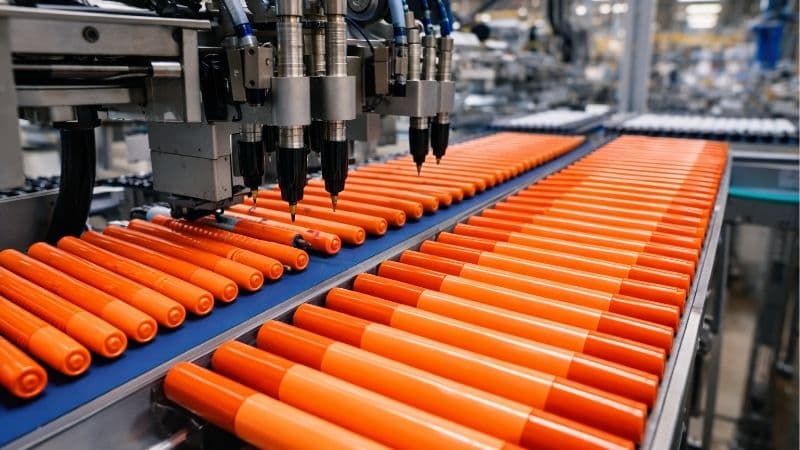
When Sharpie’s parent company, Newell Brands, overhauled its supply chain model by bringing large-scale production back to the United States, the reshoring move made waves across the market.
By investing heavily in automation at its Tennessee facilities, simplifying its network footprint, and retraining its staff, the redesign reduced reliance on extended global supply routes, improved control over manufacturing output, and increased production efficiency – all while lowering costs, avoiding workforce reductions, and even increasing wages by 50%.
For supply chain leaders considering the future of their operations, or perhaps reshoring themselves, we investigate Sharpie’s success story to reveal lessons in how workforce strategy must adapt when operating models change so fundamentally.
Reshoring alters skill demand, not just location
Moving production domestically completely changes operational emphasis from import coordination and global vendor oversight to plant performance, throughput optimization, and technical supervision.
This heavily impacts hiring priorities, as if job specifications remain aligned to a previous global sourcing model, capability gaps will quickly appear.
Reshored, modern facilities require:
- Production leaders comfortable managing capital-intensive environments
- Supervisors who understand equipment performance metrics
- Technicians trained in preventative maintenance and systems diagnostics
- Planners capable of adjusting output to live demand signals
Action for hiring leaders:
Before reshoring, conduct a structured skill audit against the future-state facility. Identify gaps in automation oversight, predictive maintenance, data interpretation, and capacity modeling, and build hiring timelines around these findings rather than retrofitting once production scales.

Automation increases the value of technical literacy
Sharpie’s redesign demonstrates that automation requires high-level skills across the workforce, as while it improves output, it increases the technical and analytical demands placed on operators and supervisors.
Operating automated production lines requires:
- Root cause analysis skills
- Comfort interpreting performance dashboards
- Ability to manage cross-functional troubleshooting
- Structured continuous improvement discipline
The return on automation investment ultimately depends on workforce competence – if capability lags behind system complexity, this will limit performance improvements and increase downtime risk.
Action for hiring leaders:
When building capability around automation, focus on candidates who have implemented or stabilized automated systems rather than those who have only operated them in steady environments. During interviews, probe for direct exposure to commissioning phases, production ramp-ups, and system troubleshooting, as these experiences indicate readiness to manage transition risk.
External hiring should also be integrated with structured upskilling pathways for existing employees before automation goes live, ensuring the workforce is prepared to support performance from day one.
Total landed cost control now depends on planning capability
A central driver behind Sharpie’s redesign was greater predictability in cost structures, particularly around freight exposure and tariff volatility. Reshoring production reduced long-haul transport dependency and simplified routing, but it also concentrated performance responsibility within domestic operations.
In a reshored, automated model, cost discipline depends less on external supplier negotiation and more on internal planning precision and continuous modeling.
To manage cost effectively in this environment, organizations need:
- Advanced demand planners
- Transport cost analysts
- Inventory optimization specialists
- Leaders comfortable modeling capacity utilization
Action for hiring leaders:
Organizations moving toward reshored or simplified networks should prioritize planners who can demonstrate measurable cost-to-serve improvements rather than static forecasting accuracy.
Interview processes should explore direct experience with scenario modeling, cost sensitivity analysis, and live capacity balancing under fluctuating demand conditions. Integrating finance stakeholders into hiring conversations helps assess whether candidates understand commercial impact beyond operational metrics.
Resilience requires mid-career depth
Sharpie’s reshoring and automation investments improved structural control over production, but infrastructure alone does not create resilience. Stability under pressure depends on the strength of the layer beneath executive leadership.
When production moves domestically, operational intensity concentrates within these facilities, and factors like performance fluctuations, equipment downtime, supplier variability, and workforce adjustments all require rapid decision-making. Without experienced mid-career leaders, tactical oversight shifts upward, which can easily overload senior leadership and reduce their bandwidth.
Mid-career professionals stabilize transformation because they:
- Translate strategy into execution
- Manage performance under disruption
- Maintain supplier and carrier relationships
- Lead frontline teams through change
In Sharpie’s redesigned model, this layer would have been essential during automation ramp-up, workforce retraining, and production scale increases.
Action for hiring leaders:
Organizations pursuing reshoring or facility modernization should first identify where operational knowledge is concentrated and where decision-making authority sits. Mapping single points of dependency reveals whether resilience relies on a small number of individuals.
Where authority remains overly centralized, hiring or developing mid-career leaders with clear execution ownership ahead of production scale-up will reduce risk before volatility exposes gaps.
For more practical guidance on attracting, securing, and retaining mid-career professionals, read our dedicated article: How to Hire Mid-Career Logistics Specialists.
Workforce retraining reduces transformation risk
A defining feature of Sharpie’s redesign was its decision to retrain rather than replace its workforce. As automation was introduced in its Tennessee facilities, employees were upskilled to manage more advanced systems, oversee quality controls, and support higher-throughput operations.
This approach preserved institutional knowledge while accelerating system adoption. Instead of introducing an entirely new workforce unfamiliar with operational history, Sharpie built technical depth on top of existing experience.
For organizations pursuing similar supply chain redesigns, structured workforce development reduces:
- Early-stage implementation errors
- Cultural resistance to automation
- Recruitment pressure in tight labor markets
- Ramp-up delays following capital investment
Action for hiring leaders:
HR, operations, and engineering leaders should align early to define future skill requirements before equipment procurement is finalized.
Retraining programs should be designed in parallel with system selection to ensure employees are prepared to operate new environments from day one, and progression into higher-skill technical roles will also improve retention during the transformation period.
External recruitment remains important, but organizations that balance targeted hiring with structured upskilling reduce transformation risk and protect long-term workforce stability.
Practical workforce questions for supply chain leaders
Sharpie’s supply chain redesign provides a useful lens for assessing transformation readiness. The questions below can help supply chain leaders evaluate whether their workforce model is aligned with their future operating structure:
- Does our workforce profile match our future production model?
- Are we building analytical capability at the same pace as capital investment?
- Where would automation expose skill deficiencies today?
- Are mid-career leaders empowered to manage transformation workload?
- Have we aligned hiring timelines with facility ramp-up schedules?
Aligning transformation with talent: DSJ Global’s perspective
Across manufacturing and logistics markets, capital investment in automation, reshoring, and network redesign is accelerating. What we consistently observe, however, is that workforce planning often trails infrastructure change.
DSJ Global partners with supply chain and operations leaders to prevent that disconnect through proactive talent planning and dedicated supply chain recruitment solutions.
We support hiring across the entire supply chain, with teams dedicated to core sectors from planning and procurement to technical operations and supply chain leadership – explore our expertise here.
We also provide market-informed advisory support through our value-adding services, such as:
- Conducting market-informed skill mapping aligned to automation and reshoring initiatives
- Identifying mid-career leaders with direct transformation experience
- Benchmarking compensation for high-demand technical profiles
- Sequencing hiring plans alongside capital deployment schedules
If your organization is modernizing its supply chain model, request a call back to discuss capability planning aligned to your transformation timelines, or submit a vacancy to immediately access experienced supply chain professionals matched to your future operating requirements.
Let’s talk talent
Request a call back and one of our experienced consultants will get in touch to discuss your hiring requirements.
Advancing your career
Want to be one step ahead in your career? Our industry experts have the relationships and global reach to realize your full potential.