

March 20263 min read
Supply Chain Control Towers and the Talent Behind Them
Supply chain control towers are becoming central to the delivery of major infrastructure projects, but their value is often misunderstood. As organizations look more closely at what is a supply chain control tower and what’s needed to deploy one, the focus is shifting away from tools and toward execution. The difference between success and failure is no longer visibility, it is the ability to act on it.
Historically, supply chain control towers were positioned as monitoring tools that provided updates on shipments and inventory. That model no longer reflects how they are used today. A modern control tower acts as a coordination layer across procurement, logistics, planning, and delivery, bringing together multiple data sources and enabling faster, more informed decisions. This is particularly important in infrastructure projects, where supply chains are fragmented and delays can impact entire programs.
What is a supply chain control tower in today’s market
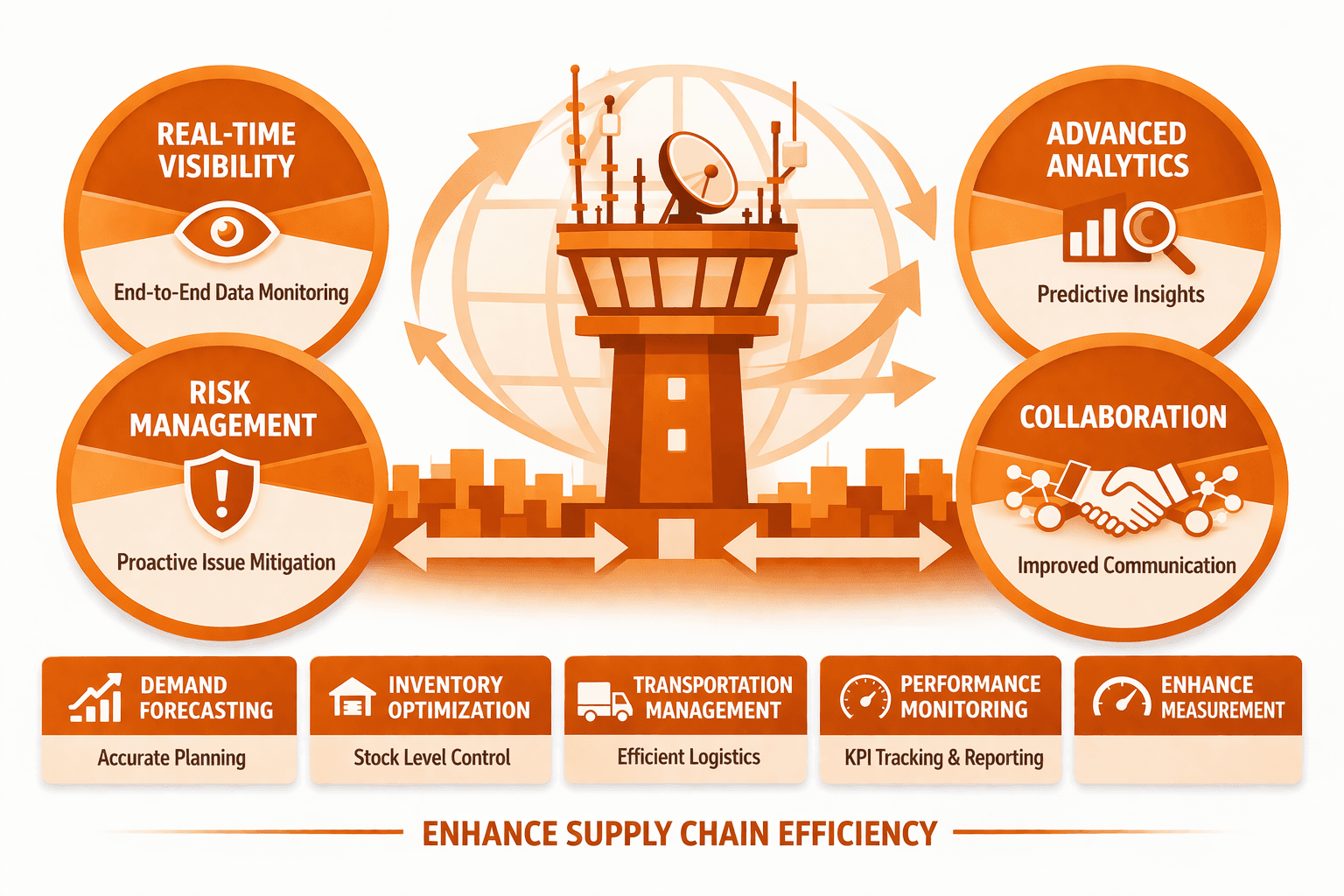
A supply chain control tower is best understood as a centralized function that connects data, systems, and stakeholders across the supply chain. It provides a single view of operations while enabling teams to identify risks, assess impact, and coordinate responses in real time.
Current platforms reflect this shift. Solutions such as SAP’s supply chain control tower integrate procurement, planning, and logistics data into one environment, while providers like project44 focus on real-time transportation visibility across global networks. Together, these tools support a more connected and responsive supply chain.
In infrastructure environments, this level of coordination is essential. Projects involve multiple contractors, global sourcing, and strict timelines, all of which require a consistent flow of accurate information to avoid disruption.
What’s needed to deploy a supply chain control tower successfully
Deploying a supply chain control tower requires more than selecting the right platform. Success depends on how well technology, operating structure, and talent are aligned from the outset.
The technical foundation must support integration across suppliers, logistics providers, and internal systems, creating a reliable flow of real-time data. In infrastructure projects, this is often challenging due to fragmented systems across contractors, which can limit visibility if not addressed early.
Equally important is how the control tower operates. Clear ownership, defined decision rights, and consistent processes are required to translate insight into action. Without this structure, teams revert to siloed decision-making and the control tower becomes a reporting layer rather than a driver of performance.
The biggest constraint, however, is talent. Control towers require individuals who can interpret data in context, understand operational trade-offs, and act quickly in complex environments. At DSJ Global, we are seeing increasing demand for this capability, particularly in infrastructure programs where organizations are investing in control towers but struggling to build teams that can operate them effectively.
The talent gap in supply chain control towers
As control towers become more advanced, the profile of the required talent is changing. These roles sit between traditional supply chain functions and data-driven decision-making, requiring individuals who can operate across both.
In infrastructure projects, this often means coordinating across multiple stakeholders while managing supply chains that span regions and suppliers with varying levels of digital maturity. Professionals need to balance operational understanding with the ability to interpret data and respond under pressure.
The market for this talent is limited. Many organizations are competing for candidates with experience in large-scale programs or digital supply chain environments, while job descriptions often fail to reflect the hybrid nature of the role. This mismatch is contributing to longer hiring cycles and delays in implementation.
Automation and the next phase of control towers
Automation is reshaping how supply chain control towers operate. Tasks that were previously managed manually, such as routing decisions and scheduling adjustments, are increasingly handled by systems that can respond in real time.
This changes the role of the control tower team. Instead of managing day-to-day execution, professionals are focused on overseeing systems, validating outputs, and managing exceptions. This requires a deeper level of expertise, particularly in environments where conditions can change quickly.
For infrastructure projects, this balance between automation and oversight is critical. While systems can optimize based on available data, they still require experienced professionals to ensure decisions align with project priorities and constraints.
2026 Update: The move toward autonomous control towers
The latest stage in this evolution is the development of autonomous supply chain control towers. These systems combine predictive analytics with automated execution, allowing supply chains to adjust continuously without direct intervention.
This represents a clear progression from visibility to prediction and now to execution. While this improves speed and efficiency, it also increases the complexity of implementation. Organizations need individuals who can design, manage, and refine these systems while maintaining alignment with business objectives.
As a result, the demand for specialized talent is expected to increase further, particularly in sectors such as infrastructure where supply chains are both complex and high-risk.
How will supply chain control towers shape the next generation of infrastructure delivery?
The answer will depend on how far organizations extend their role beyond execution. As supply chains become more complex and exposed to disruption, control towers will increasingly influence upstream decisions, from sourcing strategies to supplier selection and risk planning, rather than operating only at the delivery stage.
Its value will also be judged by how effectively they support resilience. The ability to model alternatives, respond to uncertainty, and maintain delivery momentum under changing conditions will become a key differentiator, particularly in infrastructure programs where delays have wide-reaching impact.
At DSJ Global, we are already seeing this shift take place. Organizations are no longer asking whether to implement supply chain control towers, but how to scale them and embed them into long-term strategy. This is driving demand for talent that can operate across supply chain, data, and transformation, and shaping how teams are structured to support more advanced, integrated models.
Over the next decade, supply chain control towers will move closer to the center of project and network strategy. The organizations that position them as a strategic function, supported by the right capability, will be better equipped to manage complexity and maintain control as conditions continue to shift.
If you are planning or scaling a supply chain control tower and need support securing the right talent, you can request a call back to discuss your hiring needs and access candidates with experience across supply chain, data, and transformation.
Let’s talk talent
Need the right talent for your next hire, or guidance on your people strategy? Leverage our experience to help you and your business today.
Advancing your career
Want to be one step ahead in your career? Our industry experts have the relationships and global reach to realise your full potential.